Arrakis
Arrakis DARC-S15 Bundle
Arrakis DARC-S15 Bundle
Couldn't load pickup availability
Arrakis DARC-S15 Bundle
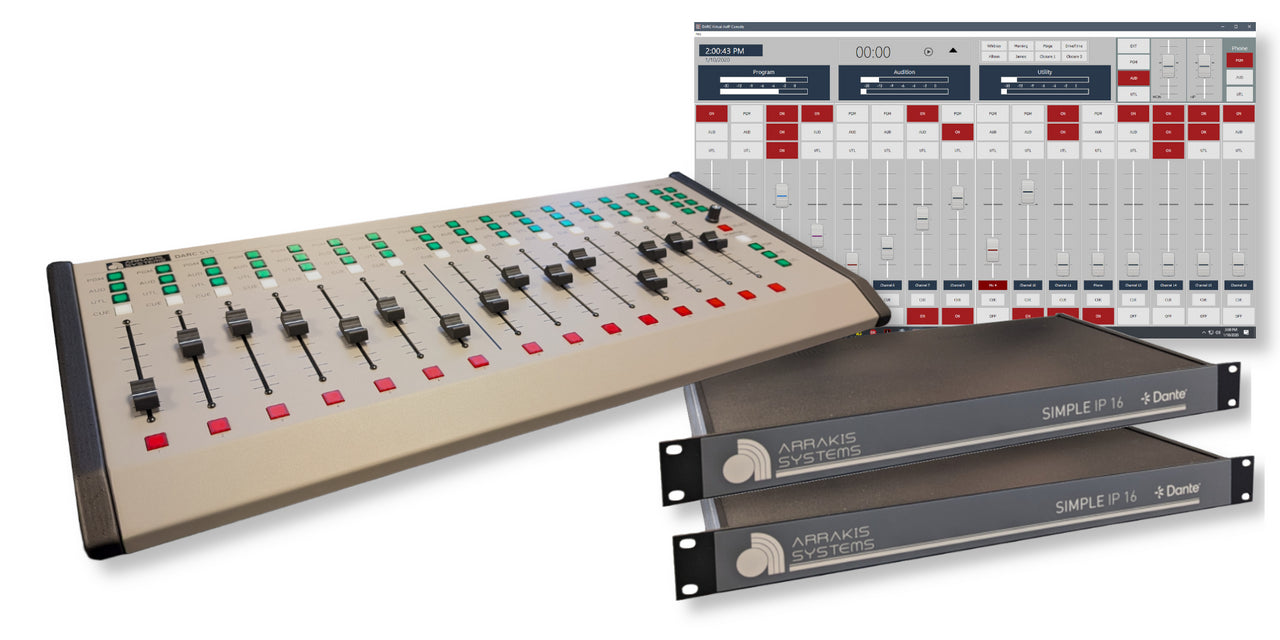
A Complete Digital Console System With Audio Networking Included The Arrakis DARC-S15 Bundle combines the DARC S15 physical control surface, a 16 channel DARC Virtual software license, and two Simple-IP-16A audio networking nodes into a single package, giving a station a complete Audio over IP mixing system rather than just the control surface on its own. This bundle handles up to 16 stereo or 32 mono audio inputs and outputs, giving a station substantial input capacity for a multi-source studio without needing to piece together the audio hardware separately from the control surface and software. The DARC S15 itself is a digital surface with no audio running through it directly, meaning it's a pure control signal path free of RF interference, while the two included Simple-IP-16A nodes handle the actual audio connections coming in and out of the system. A PC is required to run the DARC Virtual software but is not included in this bundle, so a station will need to supply a compatible Windows machine to complete the setup. For a station building out a networked studio from the ground up, this bundle removes much of the guesswork around matching a control surface, software, and audio networking hardware that actually work together. The DARC S15 Control Surface For Tactile Digital Mixing The DARC S15 is a 15 fader digital control surface, giving an operator the tactile, hands-on feel of a traditional analog board while controlling audio that's actually running through the connected Dante or AES67 network. Because the surface carries no audio signal directly, it avoids the RF interference issues that can affect traditional analog wiring, making it a clean, reliable control point regardless of what electrical noise might be present in a studio environment. Momentary switches on the surface are rated for five million operations with LED illumination, giving the same long service life found across other Arrakis console lines. The surface is designed to work in conjunction with a Windows PC running DARC Virtual, meaning the fader surface acts as the physical interface while the actual mixing and routing logic runs in software. DARC Virtual Software Managing 16 Channels Of Audio Control The included 16 channel DARC Virtual license gives the system dynamic source switching across up to 64 mono input sources, letting a station assign and reassign audio sources to console channels as programming needs change. Each source channel can be labeled programmatically, so operators always know exactly what they're controlling rather than working from generic channel numbers. Eight phone mix minus buses are included, allowing a station to connect up to eight separate phone hybrids and manage multiple caller lines simultaneously through the same system. Single channel playback, post fader, gives podcast producers the ability to stream or record each channel individually for cleaner post-production editing, while 10 point multi-touch support on compatible touchscreens lets an operator control multiple faders at once for crossfades and complex transitions. Two Simple-IP-16A Nodes For Sixteen Channels Of Analog Connectivity Each Simple-IP-16A node included in this bundle functions as an AoIP node with sixteen mono inputs and sixteen mono outputs, fully compatible with both AES67 and Dante networking standards. With two nodes included, this bundle delivers up to sixteen stereo pairs, or as many as thirty-two mono channels, of analog input and output connectivity feeding into the DARC Virtual software and controlled through the DARC S15 surface. This is where physical studio equipment, such as microphones, CD players, phone hybrids, and other analog sources, actually connects into the networked system, with the Simple-IP nodes converting that analog audio into a Dante-compatible signal on the network. Because these nodes use standard RJ45 connections and work over a normal network switch, a station can connect physical gear without complicated wiring, punch blocks, or long analog cable runs between studios. Scalable Architecture Built To Grow With A Station Because this system is built on Dante networking and AES67 compatibility, it can expand well beyond the two included Simple-IP-16A nodes as a station's needs grow, with additional Dante-enabled hardware, Dante AVIO adapters, or further Simple-IP units all able to join the same network. The DARC Virtual software itself supports configurations from 4 up to 16 channels, meaning a station starting with this bundle has room to grow the channel count in software without needing to replace the physical control surface. Advanced user presets let a station save and quickly recall entire show configurations, useful for shared studios running multiple programs or hosts throughout the day, while soft keys give quick access to closures and other custom triggered actions directly from the surface. What A Station Needs To Complete The Setup Because this bundle does not include a PC, a station will need to supply a Windows machine capable of running the DARC Virtual software to operate the system, along with a standard network switch to connect the Simple-IP-16A nodes and the control surface together. Gigabit switches with Quality of Service support are recommended for the best performance on the Dante network, though the system is designed to work with standard off-the-shelf networking equipment rather than requiring specialized or proprietary hardware. This approach keeps the bundle's cost focused on the console, software, and audio networking nodes themselves, letting a station supply computing hardware that may already be on hand or sourced independently based on its own preferences and budget.
Share